

Invisible Yet Essential: Precious Metal Materials Driving Advanced Industries
Key Takeaways
- The role of precious metals in advanced industries: Gold (Au), silver (Ag), and palladium (Pd) are widely used as functional materials in semiconductors, electronic components, and other advanced applications due to their excellent electrical conductivity, corrosion resistance, and bonding properties.
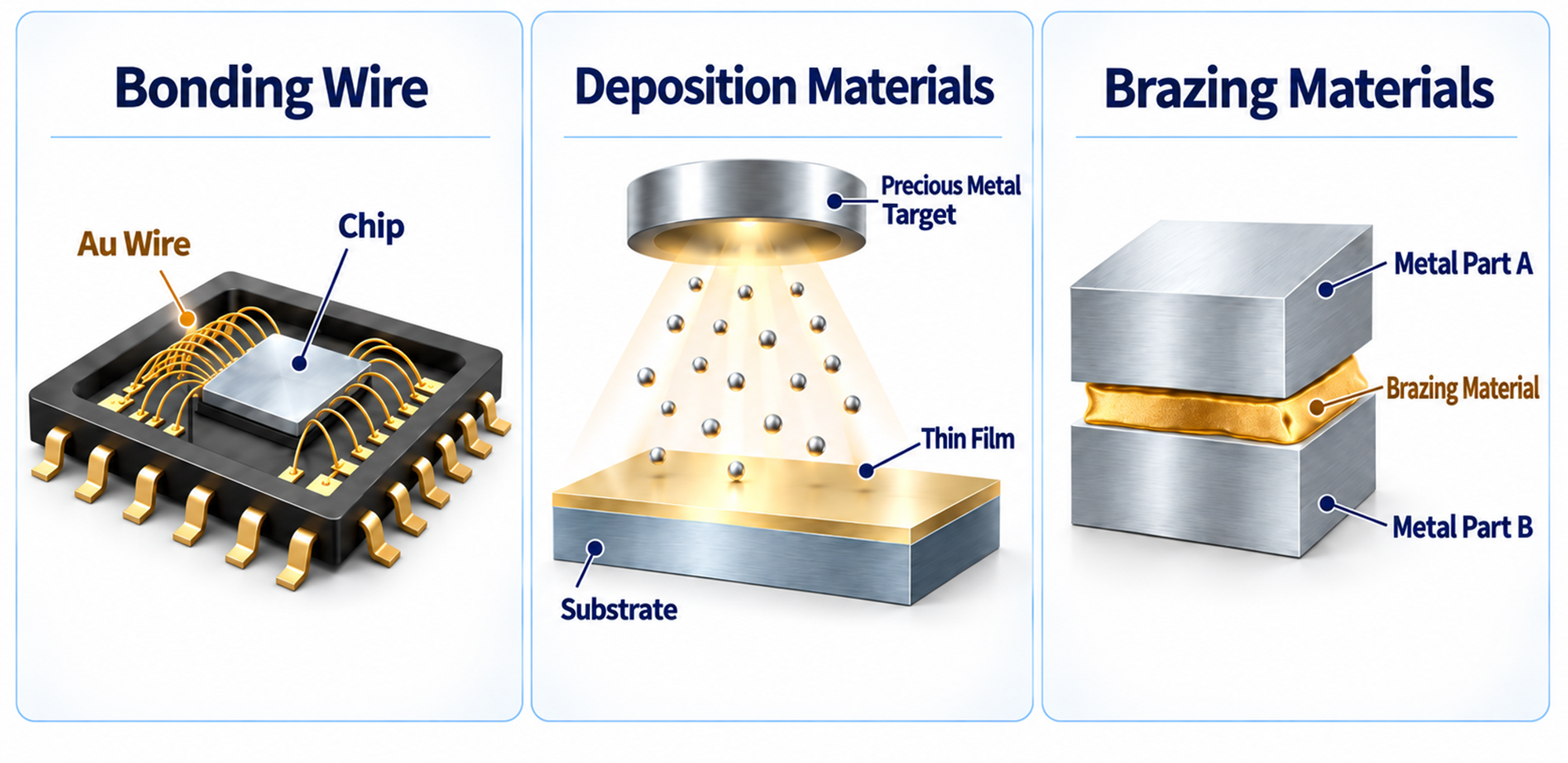
- Major industrial applications: Precious metals are used in various forms, including bonding wires, deposition materials, and brazing materials, to enable electrical connections, thin-film formation, and precision joining.
- Development of reduced-precious-metal and alternative materials: Research is increasingly focused on reducing precious metal content while maintaining required performance through alloying, the addition of other metals, and partial substitution.
Why Are Precious Metals Used as Industrial Materials?
A wide range of metallic materials can be found in the semiconductor devices, electronic components, automobiles, and other products that we use every day.
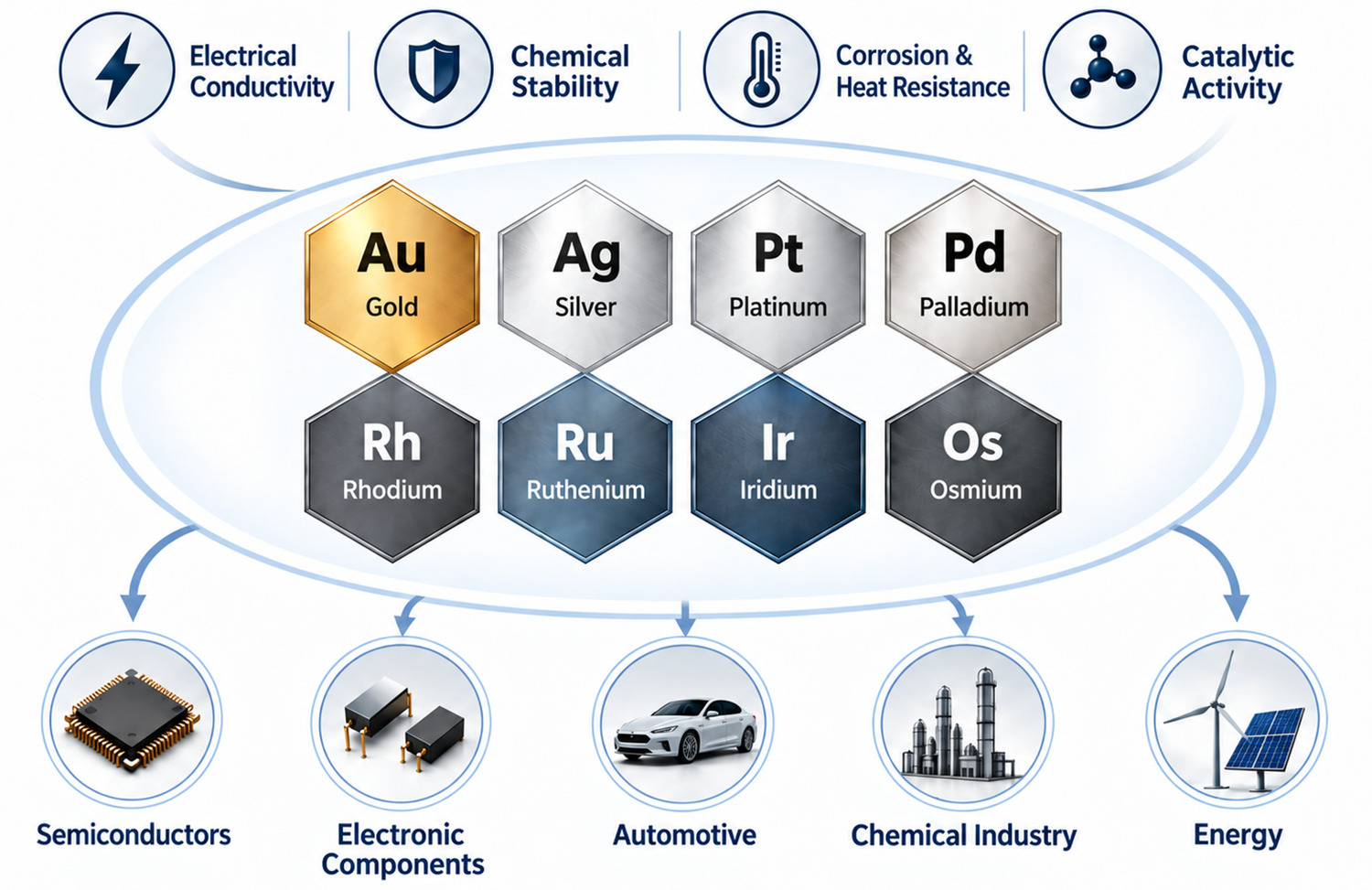
Precious metals generally refer to metals that are relatively scarce, chemically stable, and highly valued economically. In industrial applications, they typically include gold (Au) and silver (Ag), along with the six platinum group metals (PGMs): platinum (Pt), palladium (Pd), rhodium (Rh), ruthenium (Ru), iridium (Ir), and osmium (Os).
Although precious metals are commonly associated with jewelry and investment assets, their industrial value lies primarily in their distinctive material properties. Depending on the metal, they offer a combination of excellent electrical conductivity, chemical stability, corrosion resistance, heat resistance, catalytic activity, and processability.
For example, gold and silver are widely used in electrical connections and conductive pathways because of their excellent electrical properties and workability. Platinum group metals, on the other hand, are particularly valuable in applications that require high corrosion resistance, thermal stability, or catalytic performance, including the automotive, chemical, and energy industries.
These characteristics make precious metals important functional materials across a wide range of advanced industries, including semiconductors, electronic components, automotive, chemical processing, and energy. Typical applications include bonding wires for electrical connections, deposition materials for conductive thin films, brazing materials for joining components, and catalysts and electrode materials.
Although these materials are rarely visible in finished products, even small differences in their properties can affect overall product performance and long-term reliability. For this reason, developing an industrial precious metal material involves more than simply choosing a particular metal. Its composition, form, surface condition, processing conditions, and compatibility with the intended manufacturing process must all be considered.
In this article, we take a closer look at why precious metals continue to play an important role in advanced industries and how their unique properties are utilized from a materials engineering perspective.
Why Do Precious Metals Matter in Industrial Applications?
When selecting an industrial material, several properties must be considered together, including electrical conductivity, corrosion resistance, mechanical properties, processability, and bonding performance.
The widespread use of precious metals in electrical and electronic applications is closely related to this combination of properties.
Gold (Au) is chemically stable and highly resistant to oxidation, making it suitable for electrical connections where long-term reliability is important. Silver (Ag) has the highest electrical conductivity among metals and is therefore widely used in applications where efficient current conduction is required. Palladium (Pd) is also used in electrical and electronic applications where corrosion resistance and chemical stability are important.
However, the performance of an industrial material is not determined solely by the intrinsic properties of its primary metal.
ven in gold-based materials, for example, small additions of alloying elements and differences in manufacturing conditions can influence tensile strength, elongation, and bonding characteristics. Likewise, the performance of silver-based materials can vary significantly depending on the alloy composition, affecting joining temperature, mechanical properties, and processability.
For this reason, industrial precious metal materials must be designed by considering not only the properties of the base metal, but also the alloy composition, microstructure, geometry, surface condition, and manufacturing process.
Bonding Wire: Providing Electrical Connections in Semiconductor Packages
One of the most representative applications of precious metals is semiconductor packaging.
For a semiconductor chip to communicate with external circuitry, a stable electrical connection must be established between the chip and the package terminals. One widely used method is wire bonding, which uses a very fine metal wire known as bonding wire.
Gold bonding wire is a representative semiconductor packaging material that takes advantage of gold’s chemical stability and reliable bonding characteristics.
However, purity alone does not determine the quality of a bonding wire.
During the wire bonding process, the wire is continuously fed, deformed, and repeatedly bonded to the chip and terminal. Stable processing therefore requires careful control of properties such as wire diameter uniformity, tensile strength, elongation, surface condition, and bonding performance.
As semiconductor packaging technologies and cost structures continue to evolve, materials such as copper wire and Pd-coated copper wire are also increasingly used alongside traditional gold wire.
Bonding wire should therefore be viewed not simply as a fine metal wire, but as a functional material engineered to provide the mechanical, electrical, and bonding properties required for semiconductor packaging.
Deposition Materials for Thin-Film Formation
Precious metals are also used as deposition materials for forming thin metallic films on various surfaces.
In electronic components, thin metal films are often required to provide electrical functionality or create conductive pathways.
Although the amount of material used in a thin film may be very small, the composition, uniformity, and interface condition of the deposited layer can significantly influence final product performance.
Silver, for example, is widely used in conductive applications because of its excellent electrical conductivity.
In an actual deposition process, however, conductivity is only one of many factors that must be considered. Material purity, deposition stability, film uniformity, surface condition, and compatibility with subsequent processing steps can all affect the quality of the final film.
Therefore, the key to deposition materials is not simply supplying a high-purity metal, but controlling both the material and the process so that the required properties can be reproduced consistently in the final thin film.
Brazing Materials for Joining Different Components
Advanced products are rarely made from a single material. During manufacturing, different metals and components often need to be joined reliably, and one of the technologies used for this purpose is brazing.
Unlike processes that melt the base materials themselves, brazing uses a filler metal with a lower melting temperature to join components together.
Silver-containing alloys have long been used as brazing materials because of their favorable wetting and joining characteristics.
When developing a brazing material, however, it is not enough to determine whether two components can simply be joined.
Depending on the base materials and service environment, factors such as brazing temperature, wettability, joint strength, heat resistance, and long-term reliability must also be considered. The alloy composition and material form can therefore vary significantly depending on the specific application.
Brazing materials are thus another example of functional materials whose composition and properties must be tailored to the joining environment and process conditions.
Why Can Materials with the Same Precious Metal Perform Differently?
In materials research and development, it is common to find that materials with the same primary constituent exhibit different behavior during processing or in the final product.
These differences can arise from factors such as alloy composition and minor additives, material purity, grain size and microstructure, surface condition, geometry and thickness, as well as manufacturing and heat-treatment conditions.
As semiconductor and electronic components become smaller and manufacturing processes become more precise, these seemingly small differences become increasingly important.
For this reason, materials development does not end with measuring the basic properties of the raw material.
It also requires designing the composition, analyzing the microstructure and physical properties, optimizing process conditions, and verifying performance under conditions that closely reflect actual manufacturing environments.
This is why application-level evaluation is such an important part of materials research.
From Precious Metals to Advanced Functional Materials
LT Metal develops and manufactures a wide range of industrial materials based on precious metals such as gold and silver, including bonding wires, deposition materials, brazing materials, and other conductive materials.
Although these products differ in form and application, they share a common principle from a materials engineering perspective:
understanding the process and operating environment, and designing the material to deliver the properties required under those conditions.
Today, another important direction in materials development is to maintain the advantages of precious metals while reducing the amount of precious metal required or partially replacing it with other metals.
Gold and silver offer outstanding functional properties, but they are also associated with limited resources and significant price volatility.
One approach is to add other metals to precious metals to adjust alloy composition and performance. In other applications, part of the precious metal may be replaced by an alternative metal while still targeting the required performance.
Simply reducing precious metal content, however, is not enough.
Changes in composition can also affect electrical conductivity, bonding behavior, mechanical properties, heat resistance, and corrosion resistance. The key is therefore to identify the right balance between lower precious metal content and the performance required in the actual application.
Based on its accumulated expertise in precious metal materials, LT Metal continues to explore new combinations of metals and alloy designs that can reduce precious metal content while maintaining the performance required by each application.
Research is also expanding beyond conventional semiconductor and electrical/electronic applications to address material requirements in emerging industries.
Materials may not be the most visible part of a finished product. Yet every electrical connection, joint, and functional layer depends on materials designed for a specific purpose.
The fact that even a small, almost invisible difference in a material can influence the performance and reliability of an entire product is precisely what makes materials technology so important.
FAQ
Q1. Can precious metals be recycled and reused as industrial materials?
Yes. Precious metals can be recovered, refined, and reused as high-purity raw materials. Because metals such as gold, silver, and palladium have high resource value, recovery from used materials and process by-products is an important part of resource circulation. However, strict impurity control and purity management are essential when recycled materials are used in industrial applications.
Q2. How does precious metal price volatility affect material development?
Precious metals are strongly influenced by global market prices and supply-chain conditions. Material development therefore needs to consider not only performance but also cost stability and supply security. This is one of the reasons why reducing precious metal content and developing alternative materials have become increasingly important.
Q3. Can precious metals be completely replaced by other metals?
It depends on the application. Precious metals often combine several advantages, including electrical conductivity, corrosion resistance, and reliable bonding performance, which can make complete substitution difficult. In many cases, partial replacement, alloying, or surface coating is a more practical approach to reducing precious metal usage.
Q4. How important is purity in industrial precious metal materials?
Purity is an important factor, but higher purity is not always better. Some applications require very high purity, while others benefit from controlled additions of minor elements to improve mechanical or bonding properties. The optimum purity and composition therefore depend on the intended process and performance requirements.
Q5. What technologies will become more important in future precious metal material development?
Key areas are expected to include reduced-precious-metal materials, alternative material development, advanced alloy design, recycling, and resource circulation. As semiconductor and electronic components continue to become smaller and more highly integrated, precise control of composition, surfaces, and interfaces will also become increasingly important.