

What is IGZO? An oxide semiconductor material that powers high-resolution displays
What is IGZO? An oxide semiconductor material that powers high-resolution displays
Displays like smartphones, tablets, laptops, and TVs don’t just operate with light-emitting panels. To precisely turn each pixel on and off, and to control brightness and color, semiconductor devices that regulate electrical signals are required. This role is performed by TFT (Thin Film Transistor). And IGZO is a representative TFT material widely used in recent high-resolution, low-power displays. In this article, we will easily explore what IGZO is, why it is necessary for displays, and what role IGZO targets play.
1. What is IGZO?
IGZO is an acronym for Indium Gallium Zinc Oxide.
In Korean, it can be called Indium Gallium Zinc Oxide. As the name suggests, it is an oxide semiconductor material composed of indium (In), gallium (Ga), zinc (Zn), and oxygen (O).
If ITO is a transparent electrode material that passes light and conducts electricity, the biggest difference is that IGZO is an oxide semiconductor material used to turn electrical signals on and off.
To put it simply, the following.
ITO is a transparent electrode material that conducts electricity.
IGZO is a transparent semiconductor material that controls electrical signals.
IGZO is especially a representative oxide semiconductor used in display TFTs.
2. What is TFT, and why is it necessary?
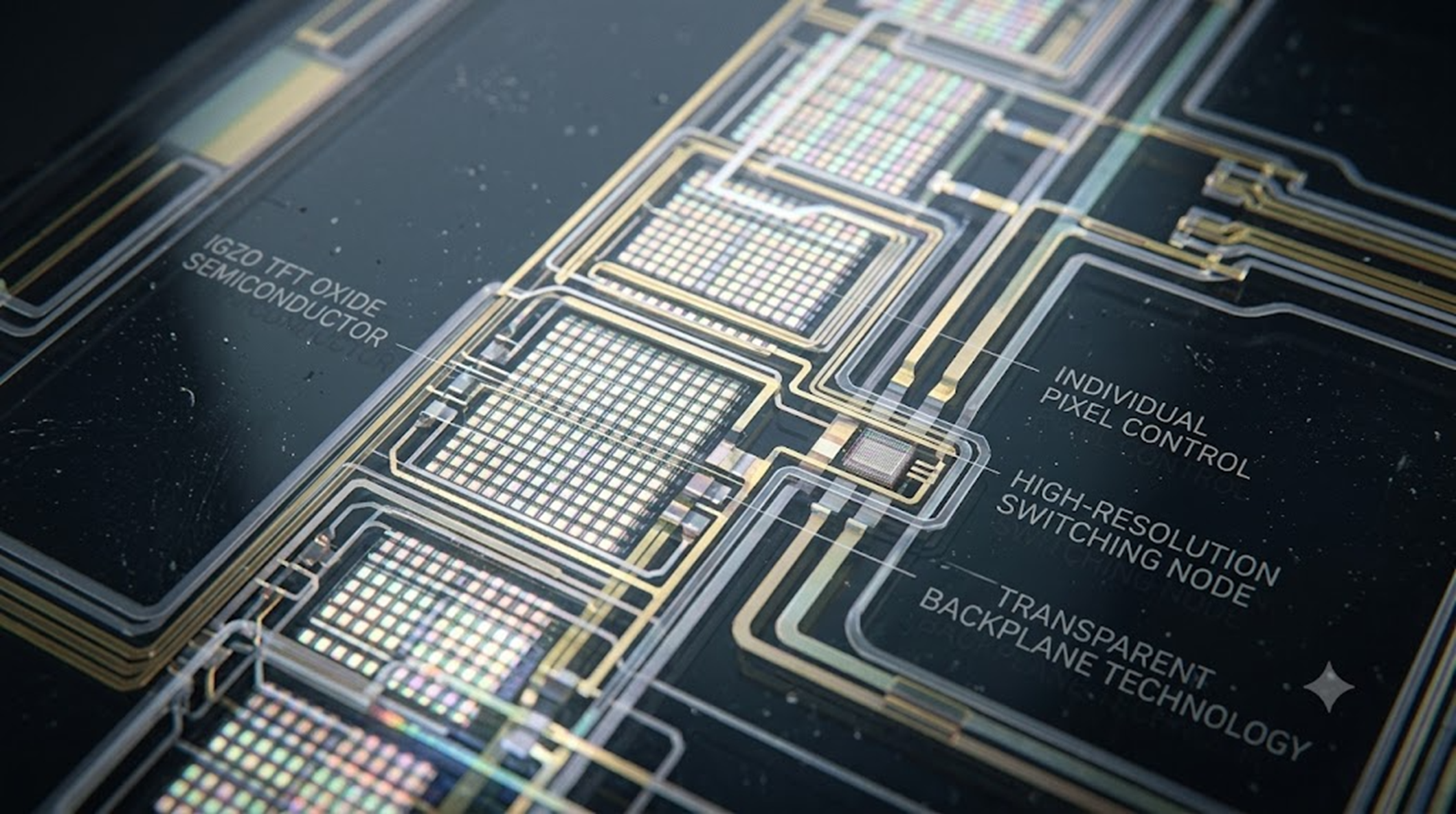
TFT stands for Thin Film Transistor, or Thin Film Transistor.
Transistors act like switches that regulate the flow of electrical signals. In displays, TFTs are needed because they control electrical signals for countless pixels.
For example, a smartphone screen has millions of pixels. To express the desired color and brightness for each pixel, electrical signals must be precisely controlled per pixel.
At this point, TFT serves the following roles:
- It transmits electrical signals to the pixels.
- Turning pixels on and off.
- It controls the brightness and color display of the screen.
- It helps display images stably.
In simple terms:
TFT is a tiny electronic switch that moves each pixel.
IGZO is a material that can be used for the semiconductor layer of such TFTs.
3. Where is IGZO used?
IGZO is primarily used in the TFT backplane of displays.
Here, the backplane refers to the circuit layer that electrically controls each pixel of the display. It’s called the backplane because it drives countless pixels behind the screen.
Smartphones and tablets: IGZO TFTs can be applied to smartphones and tablets where high-resolution screens, smooth transitions, and power efficiency are important.
Laptops and monitors: Laptops and monitors also prioritize high resolution and low power features. Especially in environments where screens are displayed for long periods, power efficiency can affect the user experience.
OLED displays: OLED structures emit light at each pixel. Precise control of each pixel’s brightness is necessary, so TFT backplane performance is vital. IGZO TFTs are used as one of the backplane materials in OLED displays. LCD displays also need TFTs to transmit and control electrical signals for each pixel. IGZO can also be applied to LCD TFT backplanes.
Sensors and electronic components: Besides displays, IGZO is researched and used in fields like sensors, light sensors, memory, and other oxide electronic devices.
4. What is the difference between ITO and IGZO?
But their most important roles are different.
However, the most important role is different.
| Category | ITO | IGZO |
|---|---|---|
| Full Name | Indium Tin Oxide | Indium Gallium Zinc Oxide |
| Primary Role | Transparent Electrode | Oxide Semiconductor |
| Key Function | Conducts electricity | Controls electrical signals |
| Main Applications | Touchscreens, Display Electrodes, OLEDs, Solar Cells | TFT Backplanes for Displays |
| Analogy | A transparent pathway for electricity | A transparent switch that turns electricity on and off |
In summary, it can be stated as follows.
ITO and IGZO have similar names and are both indium oxide materials, making them easy to confuse.
In actual displays, ITO and IGZO can be used together with different roles.
5. What is an IGZO Target?
The IGZO target is not a part that goes directly into the finished display.
The IGZO target is a raw material for deposition used to form IGZO thin films on glass or plastic substrates.
After mounting the IGZO target onto the sputtering equipment, a very thin IGZO semiconductor film is formed on the substrate.
The entire process flow is as follows.
IGZO target → sputtering → IGZO thin film on substrate → used as TFT semiconductor layer
In other words, the IGZO target is a core process material used to create TFTs that control display pixels.
6. What is the process of making IGZO thin film through sputtering?
IGZO thin films can mainly be formed through sputtering and similar thin film deposition processes.
Sputtering is a method that releases material from the target surface in a vacuum environment and deposits it as a thin layer on a substrate.
The process can be simply understood as follows:
- The IGZO target is mounted inside the sputtering equipment.
- Plasma is generated inside the equipment.
- Ions generated in plasma collide with the target surface.
- Material from the target surface is emitted.
- The emitted materials deposit on the substrate.
- A thin IGZO semiconductor film forms on the substrate.
In simple terms:
The process of coating the substrate with a very thin, uniform material from the IGZO target.
The IGZO thin film formed this way is later used as a pixel control element in displays via TFT processes.
7. What is an IGZO Target..
IGZO is a representative oxide semiconductor material based on indium, gallium, zinc, and oxygen.
If ITO is a transparent electrode that conducts electricity, IGZO is used in the TFT semiconductor layer that controls display pixels.
The IGZO target is a core material used in the sputtering process to produce such IGZO thin films.
To summarize the overall process again, it is as follows.
IGZO Target → Sputtering Process → IGZO Thin-Film Formation → TFT Semiconductor Layer → Display Pixel Control
As displays develop toward high resolution, low power consumption, and high performance, the role of the TFT backplane becomes increasingly important. IGZO is a noteworthy oxide semiconductor material in these changes, and the IGZO target can be regarded as a core process material that supports stable thin film formation.